
The Climate-Integrated Enterprise
Advisory
Business plan weakness, decision readiness and climate-informed strategy execution
I help Strategy Directors and leadership teams identify where the business plan may be weaker than it looks, and what needs to change in planning, investment, governance and delivery.
The work focuses on the assumptions and decisions that shape business performance: growth choices, investment cases, portfolio priorities, supply dependencies, operating resilience, margin exposure and delivery capacity. My specific lens is climate and resource pressure: carbon, energy, water, nature, regulation, physical risk and supply-chain fragility.
The output is not a generic risk list. It is a practical view of where the plan may be exposed, where value could be lost or created, and which decision-system changes should be made first.
What I help clients do
I work with Strategy Directors, sustainability leaders and executive teams to strengthen how climate-related risks, constraints and opportunities are considered within business planning and decision-making.
The work looks beyond commitments, disclosures and transition plans, and tests whether climate-related issues are properly reflected in the systems that guide the business.
This may reveal incomplete planning assumptions, disconnected business and transition plans, mispriced investment cases, unresolved trade-offs, exposed suppliers, weak ownership, fragmented data, or reporting activity that is not yet improving management decisions.
The aim is to identify the small number of decision points, governance gaps and ways of working that could materially affect performance, resilience, credibility or long-term value, and agree what needs to change.
How I work
My work combines diagnostic review, senior advisory input and facilitated implementation.
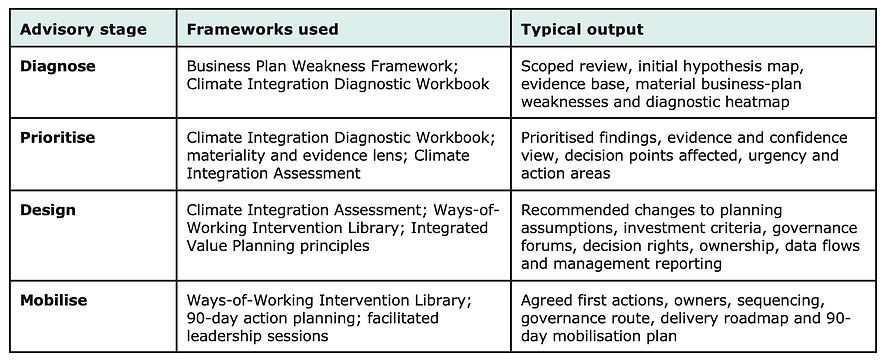
The work typically covers four stages.
1. Diagnose
Assess how well current planning, governance, investment, delivery and performance systems surface, assess, own and act on material climate-related risks, constraints and opportunities.
2. Prioritise
Identify the decision points, governance forums, planning processes and management routines where change would have the greatest effect on decision quality, resilience and value.
3. Advise
Define the practical changes needed to planning processes, decision rights, investment criteria, governance forums, performance measures, ownership, data flows and business management.
4. Facilitate
Work with leaders and cross-functional teams to design and embed the agreed changes, so climate-related issues become part of how the organisation plans, decides, governs, invests and delivers.
A structured method, not a generic review
The advisory work is supported by a set of frameworks developed through The Climate-Integrated Enterprise and Integrated Value Planning. These frameworks, together with an integrated planning ways-of-working intervention library, help make the work specific, evidence-based and practical.
They are used to identify where climate and natural-resource realities may expose weaknesses in the business plan, test which weaknesses are material and evidenced, understand the capability gaps behind those weaknesses, and define the planning, governance, investment and decision-making changes required. The intervention library then helps translate those recommendations into practical ways of working that can be selected and adapted to the client context.
The frameworks provide the structure. The advisory work applies judgement to the organisation’s actual strategy, operating model, governance and delivery context.
Benefits
The benefit is better business decision-making in a changing operating environment.
This helps clients:
-
surface material risks and opportunities earlier
-
test the assumptions behind strategy, financial plans and investment cases
-
connect transition commitments to ownership, budget and delivery
-
resolve trade-offs in the right forums, before they become delivery problems
-
strengthen resilience, credibility and long-term value
The outcome is a stronger connection between climate-related issues and the decisions that shape business performance.
Why me
I am not approaching this as a sustainability specialist looking for a route into work advising businesses. I am approaching it as a transformation and strategy execution leader who understands how business plans fail, how decisions get made, and how governance, investment and delivery systems need to change. My distinctive lens is knowing how climate, energy, water, regulation and resource pressures create weaknesses in those systems.
Start a conversation
If climate-related risks, constraints or opportunities are becoming material to your business, but may not yet be fully built into planning, governance, investment decisions or delivery, please get in touch.
